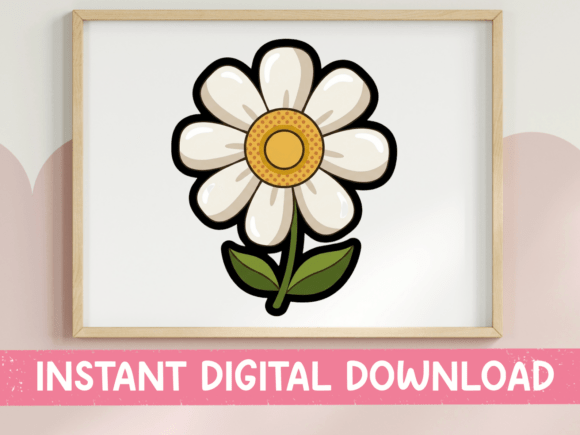
Simple White Daisy Flower Sticker Review
As a designer who spends half my life staring at stitch charts and the other half troubleshooting tension issues on my embroidery machine, I have developed a keen eye for what works in real-world production versus what looks good only on a screen. Today, I am evaluating the Simple White Daisy Flower Sticker, a graphic that promises minimalism and classic appeal. My goal here is not just to describe the image, but to dissect its viability as a commercial embroidery design asset. Will it hold up when stitched onto a $40 tote bag? Is it suitable for a delicate baby onesie? Does it translate well from a digital mockup to a tangible, washable product?
The First Impression: Clean Lines and Clear Intent
When you first look at the Simple White Daisy Flower Sticker, the immediate takeaway is its clarity. In a market saturated with intricate, over-stitched florals that often turn into muddy blobs after a few washes, this design stands out for its restraint. It features a single large white daisy with a warm golden yellow center, anchored by a short green stem and two broad leaves. This is not a chaotic garden; it is a singular statement piece.
For an embroidery designer, the "sticker" aspect of the title suggests a clean, die-cut aesthetic. When translated to thread, this means we are looking for high contrast and distinct shapes. The white petals against a colored background (or white-on-white appliqué) offer a crisp visual pop, while the golden center provides a necessary focal point that draws the eye inward. The mood is fresh, approachable, and timeless. It avoids trend-chasing, which makes it a safer bet for small business owners who want designs that will remain relevant year after year.
Real-World Application: From Screen to Stitch
I recently put this design through its paces in a simulated workflow for a boutique client specializing in handmade home goods. The concept was a line of kitchen textiles and casual apparel. Here is how the Simple White Daisy Flower Sticker performed in specific scenarios:
- Tote Bags and Canvas Goods: This is perhaps the strongest use case. A single daisy placed centrally or slightly off-center on a natural canvas tote creates an effortless, artisanal vibe. The broad leaves allow for generous fill stitches that cover the fabric texture well, preventing the underlying weave from showing through too aggressively.
- Baby Embroidery: For personalized gifts like muslin blankets or cotton rompers, the simplicity is key. Complex designs can overwhelm small garments. This daisy fits perfectly within standard hoop sizes without feeling cramped. It reads as soft and gentle, aligning well with nursery decor aesthetics.
- Sweatshirt Embroidery: On heavier fabrics like French terry or fleece, the white petals need to stand out. Using a high-quality polyester thread for the petals ensures they reflect light differently than the base fabric, adding depth. The golden center adds a touch of warmth that complements autumn-themed collections.
- Embroidered Patches: If treated as a patch design, the clean outline allows for easy trimming if needed. It serves as a versatile branding element for craft businesses, easily recognizable even at a glance in a crowded Etsy listing.
The versatility of this machine embroidery design lies in its adaptability. It works equally well as a standalone graphic on a T-Shirt Designs collection or as a subtle accent on a larger composition. As a Graphics asset, it provides a solid foundation for designers building broader seasonal themes.
Where Caution is Required
No design is universally perfect, and the Simple White Daisy Flower Sticker has specific constraints that designers must respect to ensure a professional finish.
Fabric Texture and Stability: Because the petals are likely rendered with satin or tight fill stitches, the underlying fabric must be stable. On highly textured fabrics like bouclé or loose-weave linen, the fine details of the daisy may get lost. Similarly, on stretchy knits, insufficient stabilizer usage could lead to puckering around the stem area. Always test on scrap fabric first to gauge how the thread interacts with your specific material.
Color Contrast Challenges: The white petals require a contrasting background to truly shine. On light-colored fabrics, you risk the design blending in unless you use a contrasting underlay or a slight shadow effect in the digitizing. Conversely, on very dark fabrics, the white thread might appear stark rather than soft. Careful selection of thread colors is essential here.
Small Hoop Sizes: While the design is simple, reducing it too much can compromise the integrity of the golden center. If the final product requires a tiny placement, such as on a hat brim or a small pocket, inspect the digitized file closely. Ensure the running stitches connecting the leaves do not become sparse or visible as gaps.
Impact on Brand Value and Customer Trust
In the world of handmade products and commercial embroidery, perceived quality drives sales. A poorly executed floral design can make a brand look amateurish. However, a well-stitched version of the Simple White Daisy Flower Sticker signals attention to detail. The clean lines suggest precision, which translates to customer trust in the durability of the finished product.
For Etsy sellers and small shop product creators, this design offers a low-risk, high-reward option. It is generic enough to appeal to a wide audience yet distinct enough to feel curated. It enhances handmade presentation by providing a focal point that doesn't compete with typography or other decorative elements. When used in printable mockups or digital product previews, the simplicity allows potential buyers to visualize the item in their own homes without visual clutter.
Practical Designer Notes for Execution
To get the most out of this embroidery file, consider these technical steps before committing to bulk production:
- Stabilizer Selection: Use a cut-away stabilizer for knitwear and hats to prevent distortion over time. For woven items like tea towels, a tear-away may suffice, but a water-soluble top stabilizer can help keep the white threads bright and lint-free.
- Stitch Density Check: Review the density settings in your software. If the fill stitch is too dense, the fabric may pucker. If it is too sparse, the fabric backing may show through. Adjust based on the fabric weight.
- Black and White Mockups: Convert your design preview to grayscale. This helps verify that the contrast between the white petals, yellow center, and green stem is sufficient. If the values blend together, you may need to adjust the thread shades or add a contrasting outline.
- Licensing Verification: Before using this in any craft business inventory, confirm the licensing terms. Ensure you have the right to sell finished goods made from the design assets. Some files are for personal use only, while others allow commercial application.
- Test Wash: Produce one sample and wash it according to the care instructions of the final garment. Check for thread fraying, color bleeding, or shrinkage distortion. This step is crucial for maintaining brand consistency and avoiding returns.
Ultimately, the Simple White Daisy Flower Sticker is a workhorse design. It does not scream for attention; it quietly earns it through elegance and reliability. For designers seeking a dependable addition to their library that bridges the gap between hobbyist charm and professional polish, this daisy is a strong candidate. Just remember: the difference between a good design and a great product often lies in the preparation, not just the pattern itself.